Current Lab Members

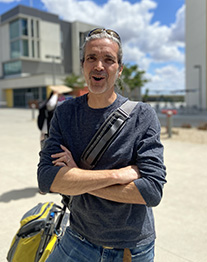
Michael N Dawson P.I. [CV]
Feel like you're drifting though life? A long way from home? Misunderstood? Odds stacked against you? Maybe you're a marine plankter. If so, Mike has a place you can stay; it's small, cold, and dark, but it's got a door and we'll get you liquored up for free. If that kills you (which it will), we'll give you PCR. It won't bring you back to life, but it will immortalize you in one of a series of fabulous studies of scyphozoan phylogenomics, comparative biogeography and phylogeography, marine population genomics, rapid evolutionary radiation in marine zooplankton, conservation genetics of marine fishes, or the community ecology of marine lakes. Learn more here.

https://scholar.google.com/citations?user=SC0-DtIAAAAJ&hl=en&oi=ao
https://www.researchgate.net/profile/Michael_Dawson34
https://ucmerced.academia.edu/MichaelDawson
twitter: @MNDlab

https://cgomo.net/
https://peeer.net/
https://biogeographynews.org/
https://biog.journals.sup.org/

Mike Mike 2017 Mike on a bike, Climate March, April 2022


\|/     []=     {-    <=    (==     (=     (‡    (‡=     (‡==


Project scientists    
none currently    
     
Post-doctoral Scholars For Future Lab Members: Postdoc opportunities  
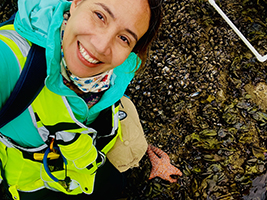
Carmen in the intertidal

Carmen Pedraza

My research focuses on studying the evolutionary processes that promote population structure, lineage diversification, and ultimately speciation in marine ecosystems. To this end, I use population genomic analyses to study the evolutionary history of co-distributed species, which, in combination with seascape genomic approaches, provides the tools to better understand the mechanisms behind local adaptation. As a postdoctoral scholar in Dawson’s lab, I will study multi-species associations on population and ecosystem dynamics under a community genomics framework to identify spatial patterns of genomic diversity, population connectivity, and responses to abiotic and biotic environmental variations. I will mainly work on the project “Biotech for Biodiversity – Exploration of an Ecological Genomic Approach to Marine Conservation,” focusing on sea star wasting and kelp ecosystem collapse, using genomics for restoration efforts. Although my previous research has been conducted using shore reef fishes as the study system, I am excited to discover the world of marine invertebrates and apply genomic approaches to investigate the drivers of evolution in marine ecosystems.

Google Scholar: https://scholar.google.com/citations?hl=en&user=XBRKwC0AAAAJ

 
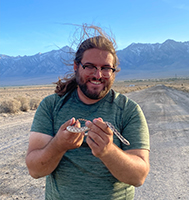
Sam holding a lizard in the desert

Sam Fellows

Sam has rejoined the lab to bring his expertise in evolutionary biology and population genomics to bear on several of our ongoing sea star projects. Sam is conducting bioinformatic analyses of whole genome resequencing data to determine [1] whether there are population genomic differences in the six-rayed sea star before versus after the sea star wasting outbreak of 2013–2015, [2] with greater precision, which loci distinguish the ochre sea star before versus after the sea star wasting outbreak, and [3] whether those differences are maintained or eroded as populations of ochre stars recover post-outbreak. These projects are led by our long-time collaborator Dr. Lauren Schiebelhut. Sam is also helping generate data for a project examining the diversity of scyphozoan jellyfishes and their photosymbionts in multiple species and populations around the world.

Google Scholar: https://scholar.google.com/citations?user=D49ZgegAAAAJ&hl=en&oi=ao


 (‡==    (‡==    (‡==    (‡==    (‡==    (‡==    (‡==


Graduate Students   For Future Lab Members: Graduate opportunities


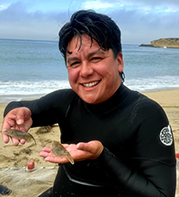
Ambrosio Rivera
(F2026 - present)


Ambrosio after diving, holding two fish

B.S. - University of California, Santa Cruz
thesis - tbd


  Hashel Orquiz
(F2025 - present)


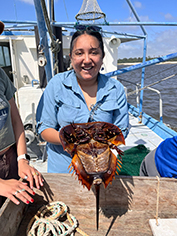
Hashel holding a horseshoe crab

B.Sc.- University of Texas, El Paso
thesis -tbd

     
    Positions open beginning every Fall semester (August). See here for any funded positions. Applications are due by mid-December of the preceding year.


(‡=     (‡=     (‡=     (‡=     (‡=     (‡=     (‡=      (‡=     


Undergraduate Students   For Future Lab Members: Undergraduate opportunities
Heidi Serna

Population dynamics of sea stars in California
  what interests you?


(‡    (‡    (‡    (‡    (‡    (‡    (‡    (‡    (‡    (‡    (‡    (‡    


Laboratory Staff
   
No positions open at this time    


(=    (=    (=    (=    (=    (=    (=    (=    (=    (=    (=    (=    


Marine Lakes Team    
     
Lori J. Bell
Laboratory Manager
& Research Scientist
Coral Reef Research Foundation
   
     
Laura Gerda sampling in a caddis fly float on a lake Sharon sitting in a caddis fly float on a lake
Laura E. Martin
Collaborator
University of California, Merced
Gerda Ucharm
Marine biologist
Coral Reef Research Foundation
Sharon Patris
Marine biologist
Coral Reef Research Foundation


(==     (==     (==     (==     (==     (==     (==     (==     (==     


Volunteers    
None at this time    


<=    {=    <=    {=   <=    {=   <=    {=   <=    {=   <=   {=   <=


L A B    A L U M N I


Project scientists    
Lauren Schiebelhut Lauren Schiebelhut:
Lauren was (and continues to be) co-PI on our projects with Revive & Restore and The Nature Conservancy exploring genomic signatures of risk and resilience in sunflower sea stars to stressors including sea star wasting. She also held her own grant as PI from the National Science Foundation comparing studying natural recolonization of sunflower stars as a comparison point with plans for rearing and outplanting sea stars in a genomic restoration project. Lauren is currently faculty at Clovis Community College and remains an active collaboraton on these projects.
Website: https://laurenschiebelhut.wordpress.com
Twitter handle: @LMSchiebelhut
GoogleScholar: https://scholar.google.com/citations?user=1MSUd00AAAAJ
Academia.edu: https://ucmerced.academia.edu/LaurenSchiebelhut
ResearchGate: https://www.researchgate.net/profile/Lauren_Schiebelhut
 
Melissa inside a cluster Melissa DeBiasse:
Melissa was (and continues) using a comparative genomics approach to understand susceptibility to wasting disease within and between sea star species. Outside of science she likes to run and bake. Melissa is now faculty at Radford University.
https://www.radford.edu/directory/profiles/biology-department/melissa-debiasse.html
https://melissadebiasse.weebly.com/
 
     
Post-doctoral Scholars    
Vanessa Dr. Vanessa Guerra (January 2020 - June 2020)
Current position: Project Scientist, USGS

Vanessa coordinated the startup phase and early fieldwork for our12-species population and community genomics project under the auspices of the California Conservation Genomics Consortium with the goal of understanding variation in susceptibilities to environmental change, species interactions, and the extent to which (and why) the historical demographies of interacting species in key habitats have been individualistic or concerted.

 
Dannise Ruiz-Ramos Dr. Dannise Ruiz (February 2017 - March 2019)
Current position: Faculty, University of Maryland, Eastern Shore University of Maryland, Eastern Shore

I am a marine biologist by training and a postdoctoral scholar with the UC Conservation Genomics Consortium. My general interests include the origins and maintenance of variation in natural populations. Marine mortality events can cause a rapid change of variation in populations over wide geographic scales. At the Dawson lab, I work on the genomics of the sea star, Pisaster ochraceous. We examine how Pisaster populations respond to the sea star-wasting disease. My aim is to characterize how the sea star-wasting disease affects sea star populations by looking at genome-level responses to the disease.

email: dannise.ruiz@gmail.com
twitter: @DanniseRuiz
GoogleScholar: https://scholar.google.com/citations?user=Zgwjck8AAAAJ&hl
ResearchGate: https://www.researchgate.net/profile/Dannise_Ruiz-Ramos

 
Lauren Dr. Lauren Schiebelhut(October 2017 - January 2019)
Subsequent position: Postdoctoral Scholar, UC Davis

Building on Lauren's PhD thesis research, which we leveraged into a proposal that was funded by the US NSF, Lauren led our field and lab campaigns to document and understand the consequences of wasting disease on sea stars in the northeastern Pacific. While focusing on the ochre sea star, and particularly an incredible decadal time-series documenting its genetic dynamics during recovery after wasting decreased, she also collected other stars for comparisons and contrasts.

https://laurenschiebelhut.wordpress.com/

 
Gio hiking Dr. Giovanni Rapacciuolo(July 2017 - November 2018)
Subsequent position: Research scientist, California Academy of Sciences

Gio was a Postdoc within the Dimensions of Biodiversity project on Palau marine lakes. His research focused on the spatiotemporal drivers of biodiversity and extinction risk across a variety of ecological systems. Additionally, he is interested in the detection and attribution of species’ recent range shifts using historical data sources, such as repeated ecological surveys and museum specimens. Find out more about Gio at giorapacciuolo.com

email: giorapac@gmail.com
twitter: @giorapac
GoogleScholar: https://scholar.google.com/citations?user=kLSLO8sAAAAJ&hl=en

 
Cynthia working in the intertidal Dr. Cynthia Hays(2010 & 2011)
Current position: Faculty, Keene State College

I'm an evolutionary ecologist, and most of my research focuses on the interplay between ecological genetics (e.g. local adaptation, rates of inbreeding) and the distributions of marine 'plants', mostly macroalgae and seagrasses. In the Dawson lab, I am contributing to a multicampus collaboration with University of California PIs Mike Dawson, Rick Grosberg, Pete Raimondi, Brian Gaylord and John Largier funded by the University of California's Coastal Environmental Quality Initiative. The goal of this project is to begin to explore the links between (1) community characteristics such as species diversity, abundance patterns, and similarity in composition across sites, (2) population genetic characteristics, including genetic diversity, patterns of allelic richness, and genetic structure across sites, of common invertebrate and algal species found in rocky intertidal habitats along the California coastline, and to examine those links in light of (3) the nearshore physical oceanography of this region and hypothesized patterns of connectivity among sites.

 
Keith with a wallaby Dr. Keith Bayha(2008 - 2010)
Current position: Project Manager - CBRN Scientific Analyst for Noblis-ESI, Washington DC

I am interested in the molecular systematics, phylogeography, population genetics and invasion genetics of scyphozoan jellyfish and ctenophores. I am working on the NSF funded REVSYS project (a collaboration between the Dawson Lab and Allen Collins at the Smithsonian Institution) examining the phylogenetic relationships, both molecular and morphological, among the semaeostome jellyfish (Cnidaria: Scyphozoa), a group that includes moon jellies, sea nettles and the lion’s mane jellyfish of Sherlock Holmes' fame. Although these jellyfish cause extensive problems worldwide as blooming and invasive species, taxonomic knowledge of this group (as is true of jellyfish in general) is relatively poor. By combining morphological and genetic data, we will greatly contribute to knowledge of species diversity within the group, morphological characters that delineate species and evolutionary relationships among species.


Graduate Students    
    Kei Fung Chan
(F2025 - Su2026)

Kei outside college, Cambridge
B.Sc. - Cambridge University, UK
M.S. - The influence of scale and demography on the
spatial distributions of motile marine invertebrates


Anabelle Klovrza
(F2023 - Su2026)

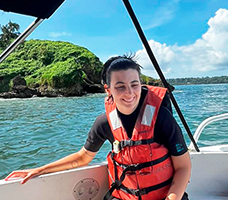
Anabelle on a boat

B.Sc. & M.Sc. - Universidade de São Paulo, Brazil
M.S. - Dichotomy or gradient? How marine lake
states are distributed in Palau

 
Sam Fellows
(F2023 - Su2025)

Sam with a lizard in the desert

B.Sc.- University of Wisconsin Milwaukee
M.Sc.- San Diego State University
Ph.D. -Investigating causes and correlates of
diversification in socially signaling squamates

Nattanon Wutthituntisil
(F2019 - Su2025)

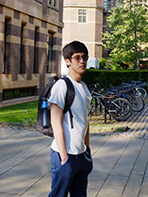
Non circa 2019

B.Sc. - Mahidol University, Bangkok, Thailand
M.S. - Patterns and processes in population
differentiation of marine invertebrates


Bailey Carlson
(F2019 - Su2025)

Bailey with a mug by the sea

B.S. - University of Hawai'i, USA
Ph.D. - Assembly and evolution of isolated marine populations using genomic and morphological methods


Karly Higgins
(F2017 - Sp2024)

Karly by the sea

B.S. - University of Wyoming, USA
PhD - Genetic and behavioral variation in motile marine holobionts (Scyphozoa-Symbiodiniaceae)

Lisa Paggeot
(F2020 - F2023)

Lisa ust back from a scuba dive

M.S. - California State University, San Francisco
MS - Reference genome and population genomics
of
Mytilus californianus

Lauren Schiebelhut
(F2010 - Sp2017)

Lauren hiking

B.S. - University of California, Merced, USA
PhD - Using large scale natural experiments to better understand the distribution of genetic variation in eastern North Pacific intertidal invertebrates


Liza Gomez Daglio
(F2007-Su2016)

Liza snorkelling sampling jellyfish

PhD - Phylogeography of shallow water jellyfish (Discomedusae) of the Eastern Pacific


Holly Swift
(F2007-Su2016)

Holly snorkelling with golden jellyfish

PhD - The ecological and evolutionary effects of environmental perturbations on populations and communities


Sarah Abboud
(S2011-Sp2016)

Sarah holding algae at the shore

MS - A global assessment of genetic diversity and distributions of medusozoans

Sharon Patris
(S2010-F2015)

Sharon in a caddis fly float on a marine lake

MS - The expansion and impact on native species of a sea anemone introduced into a tropical marine lake (Jellyfish Lake, Palau)

Joan Lehman
(2008-2010)

Joan hiking

MS - Population genetic analysis of the intertidal limpet Lottia scabra and inference of the causes and mechanisms of range limits


Laboratory Managers    
  Mira Parekh
Summer 2013 - Fall 2016

Mira with quadrats surveying sea stars in the intertidal
Adam Rosso
2016

Adam Rosso with quadrats surveying sea stars in the intertidal
Anh Nguyen
(AY2012-2013)
(formerly undergrad researcher and volunteer)
Biz Green
(AY2015)
 
Sarah Abboud
(2010)
(enrolled as graduate student in 2011)
Lauren Schiebelhut
(2009-2010)
(enrolled as graduate student in 2010)
Julia Vo
(2007-2009)
Julia in the lab
(subsequently enrolled as CSULA grad student)
Joan Lehman
(2008)
Joan hiking
(subsequently enrolled as graduate student in 2009)


Visitors   Volunteers   Undergraduates

Mariana Rocha de Souza
(F2014-Su2016 >> U. Hawai'i)

Madlen Friedrich
Christian-Albrechts-University, Kiel, Germany
Spring 2015 (8 months)

Sabah Ul-Hasan
(S2015-F2016 >> Sistrom lab)

Gerlien Verhaegen
Université Catholique de Louvain, Belgium
Spring 2014 (4 months)

Sofie Rutsaert
ERASMUS MUNDUS programme, Galway, Ireland
Spring 2014 (4 months)

Giorgio Aglieri
Università del Salento, Italy
Fall 2010 (2 months)

Celia Churchill
University of Michigan, USA
Spring 2012 (1 week) http://www.lsa.umich.edu/eeb/directory/graduates/celiakc/default.asp

Barbara Scholz
LMU München, Germany
Spring 2013 (5 months)

Mariana Souza
University of Aix en Marseille, France
Spring 2013 (4 months)

Miguel Fernandez
(F2007-S2011 >> Kueppers lab)
Ph.D. 2013 - Consequences of spatial and temporal climate variability for species distribution modeling


Judith Bayardo-Guzman
F2016-Sp2017
Mastigias polyp spatial relationships

Serafino Bodavos
Merced High School
Summer 2008
Research: Compiling data on the fecundity advantage hypothesis in jellyfish.

Annie Schimon
Kalamazoo College undergraduate
Summer 2009.
Research: Population dynamics of marine lake zooplankton in response to environmental change.


Siya Agrawal
Sp2023-Sp2026: Genetic Associations with Sex in the Sunflower Sea Star, Pycnopodia helianthoides

Charles Hu
Sp2022-Sp2024: Associations between sea star wasting and DNA methylation

Sierra Montes
F2019: Fieldwork, curation, & functional ecology

Daisy Ramos
F2019: Fieldwork, curation, & functional ecology

Roxanna Khalili
F2019: Curation & lab practices, functional ecology

Rebecca Armstrong
F2019-Sp2020: Curation & lab practices, plankton dynamics

Evan Gong
F2017-Sp2019: Curation and sample management

Carolina Karuppiah
Su2016-F2018: Curation, fieldwork, & functional ecology

Satya Karuppiah
Sp2017-F2018: Curation & lab practices

Sravani Mylavarapu
F2016: Curation & lab practices

Judith Bayardo-Guzman
Sp2015-Sp2016: Curation & lab practices

Kameron Jones
Sp2015-Su2016: Curation & lab practices

Angelica Nava
Sp2014-Sp2015: Population genetics, Palau

Victoria Onwu
Sp2014-Sp2015: Curation & morphometrics, Palau

Kiran Chauhan
F2011-Sp2014: Global change and jellyfish blooms

Jason Doornenbal
F2011-Sp2014: Population genetics of jellyfishes (Scyphozoa)

Bryanna Ludwig
F2012-Sp2014: Marine lake plankton dynamics

Aman Ahuja
F2012-Sp2013: Jellyfish blooms

Moon Park
F2011-F2012: Foraminifera diversity in marine lakes

Kirandeep Bains
F2010-Sp2012: Nerita curation

Garret Arauz
F2010-S2012: Marine lakes zooplankton dynamics

Lubna Aman
Sp2011-Su2012: Environmental diversity of marine lakes for foraminifera

Carly Stilphen
F2011-S2012: The role of long distance dispersal

Alfredo Villicana-Bedolla
F2010-S2011: Phylogeography of marine algae. Systematics of jellyfishes

David Ona
F2010: Comparative phylogeography of California marine algae

Vera Diaz
Fall 2009 - Spring 2010: Undergraduate
Fall 2010: Laboratory Assistant
Research: Jellyfish biodiversity.

Elain Nguyen
Fall 2008 - Spring 2010.
Research: Compiling data on the fecundity advantage hypothesis in jellyfish.

Emily Wilson
Fall 2008.
Research: Compiling data on the fecundity advantage hypothesis in jellyfish.

Kimberly Yan
Summer 2008.
Compiling data on gene flow correlated with different fluid regimes.